What Is The GR8 Framework?
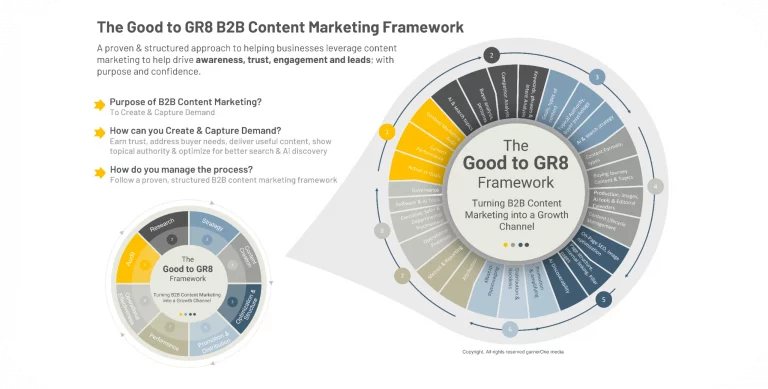
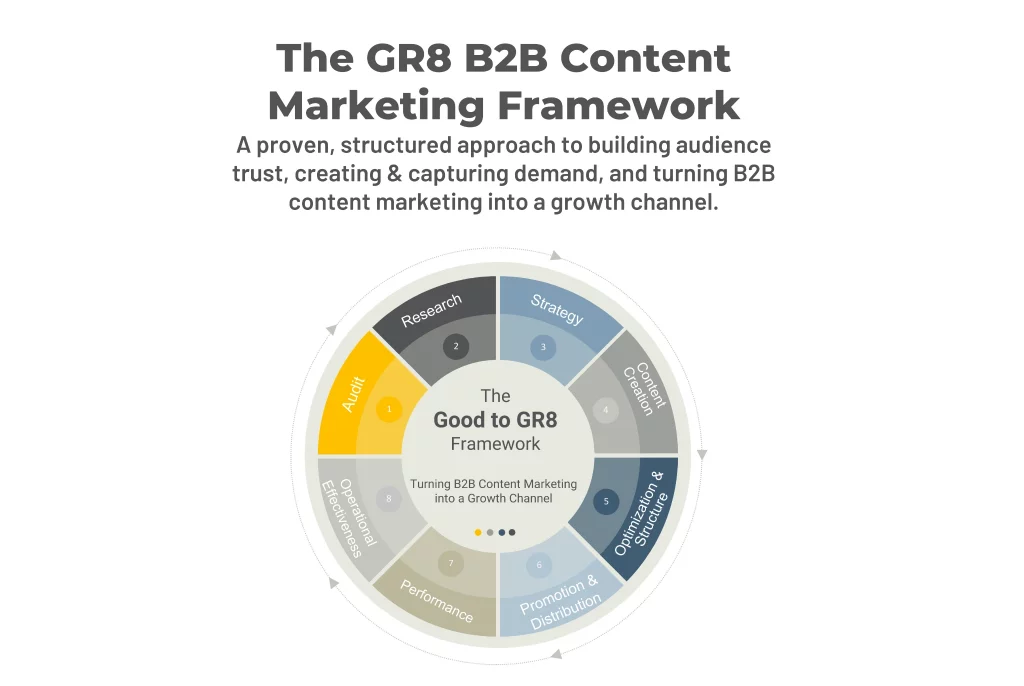
The GR8 Framework is our operating system & approach for B2B companies that want to leverage content marketing. Not only does the GR8 Framework help businesses plan, create, distribute, measure and market content with purpose and confidence, but it also provides marketers with a clear advantage by helping turn B2B Content Marketing into a growth channel.
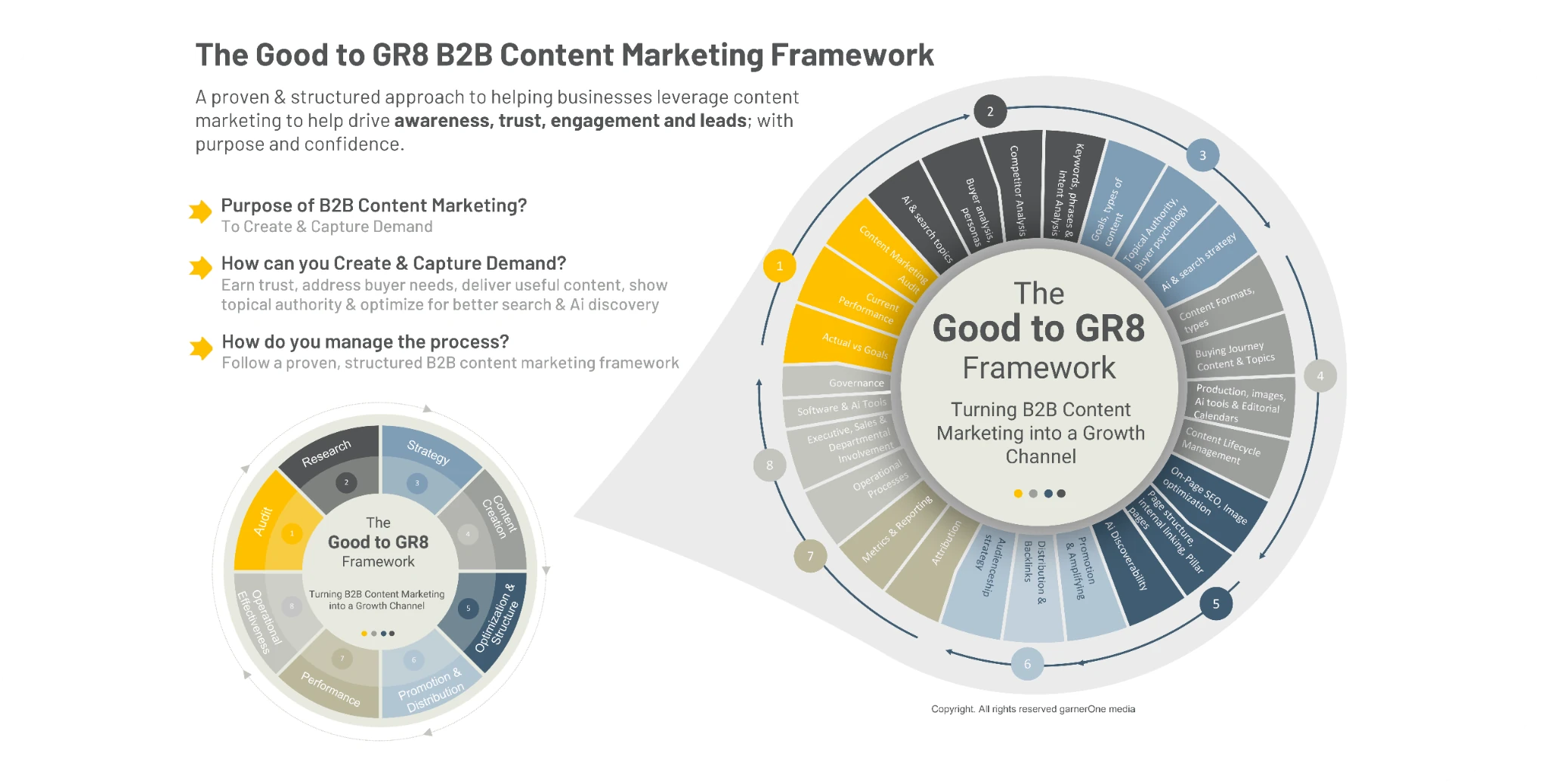
There are 8 detailed and powerful pillars within the framework; each builds on the last, guiding teams through a complete content marketing lifecycle. It is thorough, yet straightforward to understand.
Why the GR8 Framework works
Most companies create content, few leverage it into consistent growth. The GR8 Framework helps companies go beyond “doing content” by building the structure, accountability, and vision required to build a growth channel that is dependable.
When these eight pillars are followed with intention, businesses don’t just win short-term attention, they create the conditions for long-term customer growth.
Audit
Start with clarity. Audit your current content marketing situation and performance to uncover what’s working, what’s not, and how aligned your content efforts are with business goals. This diagnostic step lays the foundation for focused improvement.
You must be able to answer these basic questions:
- Are search engines discovering your content?
- Are Ai platforms referencing your content or business?
- Which keywords, phrases, questions are driving the most impact?
- Are you even targeting the right keywords/phrases your clients are searching for?
- Are your pages optimized & structured following SEO and Ai discovery best practices?
- Does your content signal that you have Topical Authority?
- Do you have mechanisms on your site to capture interest and engagement from your audience?
- Is your content working to generate enough leads?
- How effective is your content distribution strategy?
- Are you even publishing the most effective content for your audience, for search, for Ai?
About 96% of all content gets little or no traffic. Simply put, your lack of content effectiveness is probably due to one, some or all of 4 fundamental factors:
Quantity – You’re not publishing enough content
Quality – You’re not publishing the right content
Audience – Your content is not reaching the right audience
Attention – You’re not getting enough attention
The goal is to systematically audit each area and fix issues one by one.
Buyer & Market Intelligence
Most content strategy is lost right here! In fact, about 96% of all content gets little or no traffic at all.
Effective content requires understanding how buyers search, what drives their decisions, their pain points, and how to outmaneuver competitors. Without this foundation, businesses create content nobody finds or engages with, wasting resources on topics that don’t match buyer intent.
This pillar combines deep audience insight with market research to form the strategic foundation for content that performs. It goes beyond surface-level personas or keyword lists; helping you identify not just what your audience wants, but how to position your content to win against competitors.
Includes:
Buyer Intelligence: Define who your buyers are, (personas) what drives their decisions, how they search, their pain points, their vendor selection process, and their pre-sales questions
Market Intelligence: Analyze competitors you’re up against, their content strengths, topic weaknesses, their positioning in Ai answers and Search
Keyword/Phrase Discovery: Identify content opportunities tied to intent, pain points, and buyer questions
Search Criteria: Score and prioritize how users are searching for your type of solutions or business. (In Ai platforms, Search, Social, etc)
Content Format Preferences: Identify which formats your audience engages with most (e.g., comparison pages, tutorials, templates, calculators)
Industry Insight: Analyze industry nuances that reflect the way your buyers may think or act
Distribution Channels: Where is your audience? Which channels will perform best?
Positioning Opportunities: Spot areas that your brand can own
Strategy
Content Strategy is much more than just creating or publishing content. It’s about strategically planning how to engage your audience, through content, so you can fuel real engagement and position your business as an indispensable resource.
Today’s audiences demand education over interruption. They don’t need more content or ads, they need answers. Your strategy should not focus on “selling”, rather focus on providing more help, more guidance and more empowerment so they can do their job better.
An effective Content Strategy typically includes:
Philosophy or Doctrine: Do you have an overarching philosophy about the content you wish to provide your audience? (this belief or philosophy will dictate how you approach content marketing)
The Age of Ai Strategy: If everyone uses Ai to produce optimized, content rich topics at scale, then how exactly will Ai platforms or Search decide to reference your business? What differentiates your content from everyone else’s? You need a strategy that’s not like everyone else’s.
Topical Authority or Domination: Design page structures and content depth that showcases Topical Authority to audiences, Ai and search.
Map content to intent stages (awareness, consideration, and decision). Aligning content with audience intent and search behavior helps improve audience engagement.
Determine Content formats to prioritize trust and engagement (articles, whitepapers, quizzes, eGuides, etc)
Consider competing on generosity. By freely offering ideas, insights, and expertise you demonstrate leadership and outshine AI-generated or surface-level content.
We guide our clients through a full, practical, repeatable Content Strategy process that helps turn your B2B content marketing efforts into a consistent, measurable source of engagement and qualified leads.
Rooted in what today’s buyers actually respond to, help before hype.
Creation & Production
This is where strategy meets execution. Content & Production focuses on aligning your content with audience intent, delivering meaningful value, and producing assets with purpose.
Considerations:
-Understanding the HEART technique to creating content that buyers will actually engage with
-Selecting formats (blog, video, tools, guides, etc.) to enhance engagement and reach
-Defining content types (educational, comparison, conversion)
-Uniqueness of content compared to generic Ai and competition
-Building editorial calendars and production workflows
-Writing Quality: write for clarity, stick to relevance, cover the topic in full, match writing to intent. Producing superior content ensures your content stands out in comparison to your competition.
-Repurposing content across multiple channels and formats
-Brand voice, tone, and editorial guidelines
-Aligning content with requirements of sales team
-Content lifecycle (refresh, archive, sunset)
Optimization & Structure
Even great content fails if it isn’t structured to perform. This pillar is all about how your content functions, how it’s structured, linked, and experienced. Optimization makes content more discoverable by Ai platforms, search engines, easier to navigate for users, and more effective at guiding visitors toward action.
Key elements include:
Ai Search Optimization: Structuring content to be referenced by Ai helps Ai engines discover and reference your content with more ease. (schema, citations, data, summaries, etc)
EEAT: Follow Google’s Helpful Content and E-E-A-T guidelines
On-Page SEO: Optimizing headlines, meta tags, headings, image alt text, schema markup, and overall content structure.
Internal Linking: Building smart content pathways that connect related topics and help both users and crawlers navigate your expertise.
Content Structure & Page Layout: Using readable formatting, clear hierarchies, and scannable sections to improve engagement.
Topical Clusters & Pillar Pages: Organizing content into structured themes to improve topical authority and SEO performance.
Conversion Pathways: Strategically placing CTAs, forms, offers, and lead magnets based on page intent and user journey.
User Experience (UX) Flow: Ensuring the site’s visual and navigational experience helps users stay longer and find what they need.
Backlinks & Citations: Acquiring quality backlinks and citations that reinforce content authority and drive external traffic.
When done right, optimization amplifies your content ecosystem so it can be seen, understood, and acted upon not only by Ai platforms and search engines, but also your potential audience.
Distribution
If content isn’t seen, it doesn’t matter. This pillar ensures your best ideas are amplified across the right channels and helps you build long-term reach through owned and earned strategies.
Includes:
- Multi-channel distribution (social, LinkedIn, Facebook, Reddit, email, search, communities, forums)
- Paid and organic content promotion
- Repurposing content
- Audienceship: building direct, owned access to your audience instead of only counting on rented channels
Performance
You can’t improve what you don’t measure. Track results and prove what’s working. This pillar brings measurement and accountability to your content program. It helps you understand what’s driving impact, and where to optimize further.
Includes:
- Content KPIs performance
- Attribution and ROI tracking
- Performance reporting (Ai referencing, Search performance, attribution, engagement, leads, conversions, etc)
- Insight to inform strategy and planning
- Content Insight in C-suite language (using language so your finance folks understand how marketing is performing)
Operations
Align your people, tools, and processes. To scale content marketing effectively, you need operational excellence. This pillar ensures that leadership, departments, and technology all work together to support consistent execution.
Considerations:
- Executive buy-in and leadership support
- Departmental Participation (sales, product, etc.)
- Tech stack: Ai tools, CMS, Search tools, and content marketing tools
- SOPs, training, and onboarding documentation
- Governance (approval processes, brand voice, compliance)